
This module provides demand for forestry products via the interface
pm_demand_forestry to the modules 32_forestry and 62_material, and merges production of timber
from different sources into the interface vm_prod, which is
used in the 17_production and 21_trade modules.
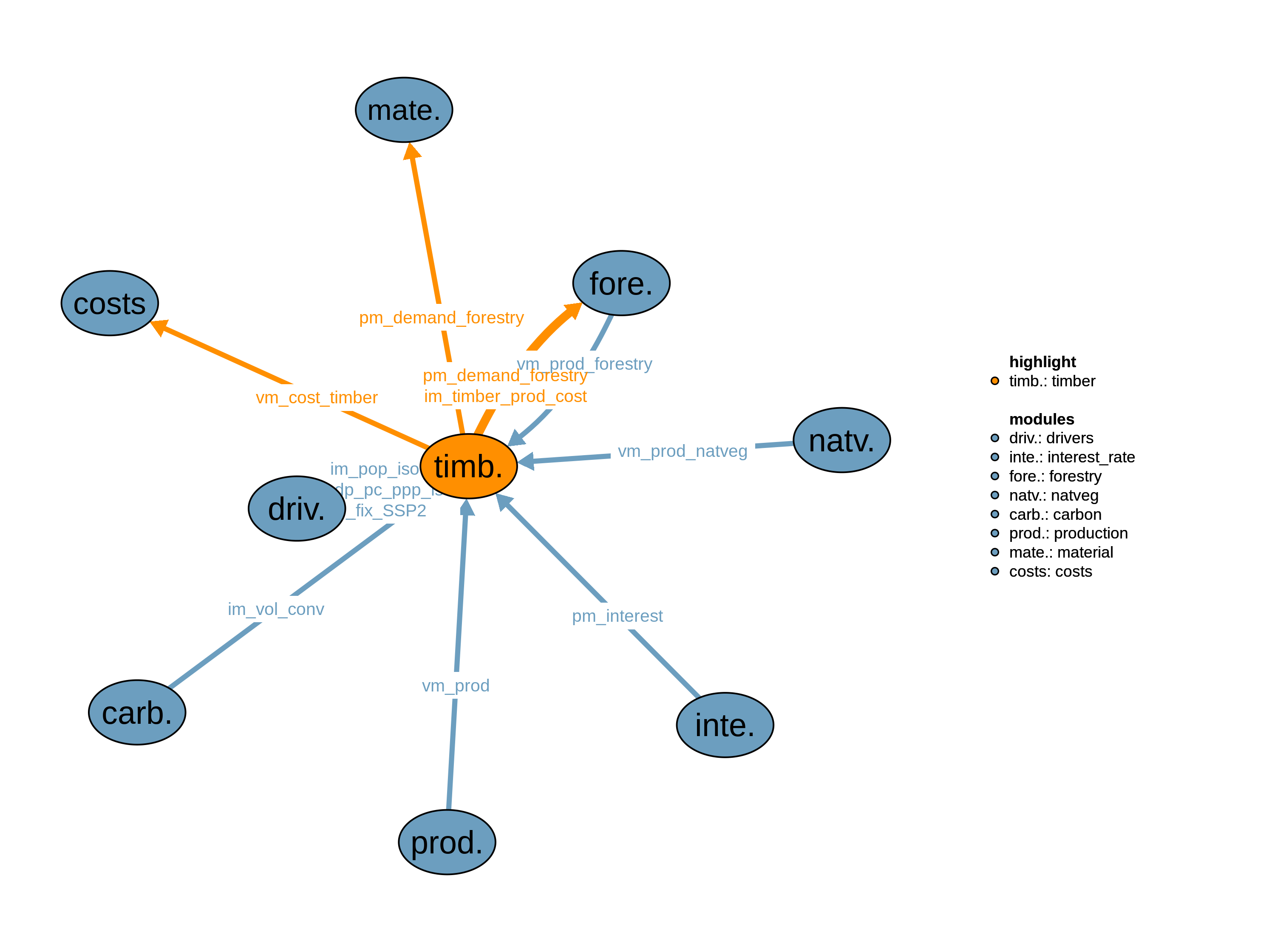
| Description | Unit | A | |
|---|---|---|---|
| im_gdp_pc_ppp_iso (t_all, iso) |
Per capita income in purchasing power parity | \(USD_{17PPP}/cap/yr\) | x |
| im_pop_iso (t_all, iso) |
Population | \(10^6/yr\) | x |
| im_vol_conv (i) |
Regional basic wood density | \(tDM/m3\) | x |
| pm_interest (t_all, i) |
Interest rate in each region and timestep | \(\%/yr\) | x |
| sm_fix_SSP2 | year until which all parameters are fixed to SSP2 values | \(year\) | x |
| vm_prod (j, k) |
Production in each cell | \(10^6 tDM/yr\) | x |
| vm_prod_forestry (j, kforestry) |
Production of woody biomass from commercial plantations | \(10^6 tDM/yr\) | x |
| vm_prod_natveg (j, land_natveg, kforestry) |
Production of woody biomass from natural vegetation | \(10^6 tDM/yr\) | x |
| Description | Unit | |
|---|---|---|
| im_timber_prod_cost (i, kforestry) |
Regional base cost for timber production based on UNECE market prices | \(USD_{17MER}/tDM\) |
| pm_demand_forestry (t_ext, i, kforestry) |
Extended demand for timber beyond simulation | \(10^6 tDM/yr\) |
| vm_cost_timber (i) |
Actual cost of harvesting timber from forests | \(10^6 USD_{17MER}/yr\) |
In this realization, aggregated timber demand for wood and woodfuel
pm_demand_forestry is calculated based on demand equation
from Lauri et
al. (2019) and income elasticities from Morland et al. (2018). See
Mishra et al.
(2021) for more details. This realization
can also account for construction wood demand based on Churkina et al. (2020)
which is added on top of industrial roundwood demand (see Mishra et al. (2022)). FAO demand volumes (m3) are
converted to dry matter (tDM) using IPCC climate-zone-specific basic
wood density (im_vol_conv). For woodfuel, a stacking factor
(0.65) is applied before density conversion to correct for FAO reporting
in stacked m3 rather than solid m3. Timber can be produced from both
timber plantations vm_prod_forestry provided by 32_forestry and natural vegetation
vm_prod_natveg provided by 35_natveg. Production costs differentiate
between plantation and natural vegetation sources, with natveg paying a
per-tDM premium reflecting higher extraction costs. Logging residues
from both roundwood and woodfuel harvest can contribute to woodfuel
supply. Natural-vegetation harvest capacity (primary forest, secondary
forest and other land) is treated as a depreciating capital stock
(s73_sticky_harvest), so ramping a harvest source up or
down carries an annuitized cost. This damps the timestep-to-timestep
switching between harvest sources while leaving the FRA-pinned wood
volume and the carbon curves unchanged.
Timber production cost has six components: 1. Base production cost:
all timber (plantation + natveg) pays
im_timber_prod_cost(i) per tDM, regionalized via wood
density (source: 89/44 USD17MER/m3 for wood/woodfuel). 2. Natveg cost
premium: natveg timber pays an additional
s73_natveg_cost_premium (15%) on top of the base cost. This
reflects higher processing costs for heterogeneous natural forest
timber. When premium is zero, the term vanishes. 3. Residue removal
cost: s73_residue_removal_cost (2.7 USD17MER/tDM) for
collecting logging residues (branches, tops) from the harvest site. 4.
Slack variable cost: s73_free_prod_cost (1e6 USD17MER/tDM)
— prohibitively high cost for the slack variable
v73_prod_heaven_timber, used only as a last resort to
ensure technical feasibility when timber demand cannot be met from
available forest resources.
\[\begin{multline*} vm\_cost\_timber(i2) = \sum_{cell(i2,j2),kforestry}\left( vm\_prod(j2,kforestry) \cdot im\_timber\_prod\_cost(i2,kforestry)\right) + \sum_{cell(i2,j2),land\_natveg,kforestry}\left( vm\_prod\_natveg(j2,land\_natveg,kforestry) \cdot \left(i73\_timber\_prod\_cost\_natveg(i2,kforestry) - im\_timber\_prod\_cost(i2,kforestry)\right)\right) + \sum_{cell(i2,j2)} v73\_prod\_residues(j2) \cdot s73\_residue\_removal\_cost + \sum_{cell(i2,j2),kforestry}\left( v73\_prod\_heaven\_timber(j2,kforestry) \cdot s73\_free\_prod\_cost\right) \cdot ' 5. Sticky harvest-capacity investment: annuitized cost of expanding natveg harvest capacity \cdot ' \left(see `q73\_invest\_harvest`\right). Zero when `s73\_sticky\_harvest`=0 or at the ord(t)=1 seed step. + \sum_{cell(i2,j2),land\_natveg} v73\_invest\_harvest(j2,land\_natveg) \cdot \sum_{ct}\left(\frac{ \left(pm\_interest(ct,i2) + s73\_hvcapital\_depreciation\right) }{ \left(1+pm\_interest(ct,i2)\right)}\right) \cdot ' 6. Symmetric down-ramp penalty: annuitized cost of reducing natveg harvest below the existing capacity \cdot ' \left(see `q73\_disinvest\_harvest`\right), at the same per-unit rate as the up-ramp. + \sum_{cell(i2,j2),land\_natveg} v73\_disinvest\_harvest(j2,land\_natveg) \cdot \sum_{ct}\left(\frac{ \left(pm\_interest(ct,i2) + s73\_hvcapital\_depreciation\right) }{ \left(1+pm\_interest(ct,i2)\right)}\right) \end{multline*}\]
Natveg harvest of each source needs a capital stock proportional to
production (p73_hvcapital_need); investment covers the gap
above the pre-existing (depreciated) stock, so ramping up is costly
while steady/falling harvest is free. p73_sticky_active
zeroes it at the ord(t)=1 seed step or when the switch is off.
\[\begin{multline*} v73\_invest\_harvest(j2,land\_natveg) \geq \left( \sum_{kforestry} vm\_prod\_natveg(j2,land\_natveg,kforestry) \cdot \sum_{cell(i2,j2)}\left( \sum_{ct} p73\_hvcapital\_need(ct,i2,land\_natveg)\right) - \sum_{ct} p73\_hvcapital(ct,j2,land\_natveg) \right) \cdot \sum_{ct} p73\_sticky\_active(ct) \end{multline*}\]
Symmetric down-ramp penalty: shedding capacity faster than it naturally retires is penalized like building it, damping the free down-leg of the sawtooth. Zeroed with the up-ramp at the ord(t)=1 seed step / when off.
\[\begin{multline*} v73\_disinvest\_harvest(j2,land\_natveg) \geq \left( \sum_{ct} p73\_hvcapital(ct,j2,land\_natveg) - \sum_{kforestry} vm\_prod\_natveg(j2,land\_natveg,kforestry) \cdot \sum_{cell(i2,j2)}\left( \sum_{ct} p73\_hvcapital\_need(ct,i2,land\_natveg)\right) \right) \cdot \sum_{ct} p73\_sticky\_active(ct) \end{multline*}\]
The following equations describes cellular level production (in dry
matter) of woody biomass vm_prod as the sum of the cluster
level production of timber coming from ‘vm_prod_forestry’ and
‘vm_prod_natveg’. When production capabilities are exhausted, the model
can produce roundwood without using any land resources but by paying a
very high cost (‘s73_free_prod_cost’). Timber production equation is
split in two parts, one each for industrial roundwood and wood fuel
production. Woodfuel production, in addition to usual production
channels, can also use residues left from industrial roundwood harvest
for meeting overall wood fuel production targets.
\[\begin{multline*} vm\_prod(j2,"wood") = vm\_prod\_forestry(j2,"wood") + \sum_{land\_natveg}vm\_prod\_natveg(j2,land\_natveg,"wood") + v73\_prod\_heaven\_timber(j2,"wood") \end{multline*}\]
\[\begin{multline*} vm\_prod(j2,"woodfuel") = vm\_prod\_forestry(j2,"woodfuel") + \sum_{land\_natveg}vm\_prod\_natveg(j2,land\_natveg,"woodfuel") + v73\_prod\_residues(j2) + v73\_prod\_heaven\_timber(j2,"woodfuel") \end{multline*}\]
Production of residues is calculated based on
s73_residue_ratio. This fraction of total timber harvest is
assumed to be recoverable as harvest residues (branches, tops, bark).
The theoretical potential of logging residues is 27% of stem harvest
(Oswalt et al.
2019). The average technical recovery rate is 52% (Thiffault et al.
2015), giving 0.27 * 0.52 = 0.14 ~ 0.15. Independently, (Di Fulvio et al.
2016) report technically recoverable logging residues at
13.5% of roundwood volume for the EU28. Residues are generated from all
real harvest sources (forestry plantations and natural vegetation) for
both products. The slack variable v73_prod_heaven_timber is
excluded (no real harvest = no residues). v73_prod_residues
itself is also excluded to avoid circularity.
\[\begin{multline*} v73\_prod\_residues(j2) \leq \left(\sum_{kforestry} vm\_prod\_forestry(j2,kforestry) + \sum_{land\_natveg,kforestry} vm\_prod\_natveg(j2,land\_natveg,kforestry)\right) \cdot s73\_residue\_ratio \end{multline*}\]
Sticky natveg harvest-capacity cost (see input.gms / equations.gms). Map the per-source intensity switches into a land_natveg-indexed parameter (config can only set scalars). Higher intensity = stronger temporal damping of that source’s harvest ramps. Capital required per unit of natveg timber production: the natveg per-tDM harvest cost, scaled by the per-source intensity and capitalized by dividing by (interest + depreciation), analogously to the sticky cost in module 38. Active from the second timestep (ord(t)>1) when on; no sm_fix_SSP2 gate (a scenario-invariant cost feature, like the sticky cost in module 38). The ord(t)=1 step seeds the capital via the postsolve warm-start. Depreciate the capital stock carried from the previous timestep (the stock at ord(t)=1 is zero).
Update the natveg harvest-capacity capital carried into the next timestep. While inactive (the ord(t)=1 seed step, or when off) it tracks the solved production, warm-starting the capital for the first active step; while active it accumulates this timestep’s net investment (mirrors the sticky cost in module 38).
Limitations Timber demand cannot be determined endogenously
| Description | Unit | A | |
|---|---|---|---|
| f73_construction_wood_demand (t_all, i, pop_gdp_scen09, build_scen) |
Construction wood demand | \(10^6 tDM\) | x |
| f73_demand_modifier (t_ext, scen_73) |
Factor diminishing paper use | \(1\) | x |
| f73_income_elasticity (total_wood_products) |
Income elasticities of wood products | \(1\) | x |
| f73_prod_specific_timber (t_all, iso, total_wood_products) |
End use timber product demand | \(10^6 m3/yr\) | x |
| f73_regional_timber_demand (t_all, i, total_wood_products) |
End use timber product demand | \(10^6 m3/yr\) | x |
| i73_timber_prod_cost_natveg (i, kforestry) |
Regional cost for timber production from natural vegetation incl natveg premium | \(USD_{17MER}/tDM\) | x |
| p73_demand_constr_wood (t_all, i) |
Demand for construction wood | \(10^6 tDM/yr\) | x |
| p73_demand_modifier (t_all) |
Simple demand modifier for construction wood | \(10^6 tDM/yr\) | x |
| p73_forestry_demand_prod_specific (t_all, iso, total_wood_products) |
End product specific timber demand | \(10^6 m3/yr\) | x |
| p73_fraction (t_all) |
Fraction over which construction wood demand is spread out | \(1\) | x |
| p73_fraction_sm_fix | Modifier fraction at sm_fix_SSP2 time step | \(1\) | x |
| p73_glo_wood (t_all, kforestry) |
Global wood demand | \(10^6 tDM/yr\) | x |
| p73_hvcapital (t, j, land_natveg) |
Preexisting natveg harvest-capacity capital stock before investment | \(10^6 USD_{17MER}\) | x |
| p73_hvcapital_intensity (land_natveg) |
Sticky harvest-capacity cost intensity per natveg source | \(1\) | x |
| p73_hvcapital_need (t, i, land_natveg) |
Harvest-capacity capital required per unit natveg timber production | \(USD_{17MER}/tDM\) | x |
| p73_income_elasticity (t_all, iso, total_wood_products) |
Income elasticities of wood products | \(1\) | x |
| p73_sticky_active (t) |
Sticky harvest-capacity mechanism active this timestep (0 at the ord(t)=1 seed step or when switched off) | \(1\) | x |
| p73_timber_demand_gdp_pop (t_all, i, kforestry) |
Timber demand based on lauri et al 2019 | \(10^6 m3/yr\) | x |
| q73_cost_timber (i) |
Actual cost of harvesting timber from forests | \(10^6 USD_{17MER}/yr\) | x |
| q73_disinvest_harvest (j, land_natveg) |
Reduction of natveg harvest below existing harvest capacity | \(10^6 USD_{17MER}/yr\) | x |
| q73_invest_harvest (j, land_natveg) |
Investment into natveg harvest capacity | \(10^6 USD_{17MER}/yr\) | x |
| q73_prod_residues (j) |
Production of residues from industrial roundwood harvest | \(10^6 tDM/yr\) | x |
| q73_prod_wood (j) |
Production of industrial roundwood | \(10^6 tDM/yr\) | x |
| q73_prod_woodfuel (j) |
Production of wood fuel | \(10^6 tDM/yr\) | x |
| s73_expansion | Construction wood demand expansion factor by end of century based on industrial roundwood demand as base | \(1=100 percent increase\) | x |
| s73_free_prod_cost | Very high cost for settling demand without production | \(USD_{17MER}/tDM\) | x |
| s73_hvcapital_depreciation | Depreciation rate of harvest-capacity capital | \(share/yr\) | x |
| s73_hvint_other | Sticky harvest-capacity cost intensity for other land | \(1\) | x |
| s73_hvint_primf | Sticky harvest-capacity cost intensity for primary forest | \(1\) | x |
| s73_hvint_secdf | Sticky harvest-capacity cost intensity for secondary forest | \(1\) | x |
| s73_income_threshold | Threshold for income-elastic industrial roundwood demand | \(USD_{17PPP}/cap/yr\) | x |
| s73_natveg_cost_premium | Cost premium for natveg timber production relative to plantation | \(1\) | x |
| s73_residue_ratio | Proportion of timber harvest recoverable as logging residues such as branches and tops | \(1\) | x |
| s73_residue_removal_cost | Cost of removing residues left after industrial roundwood harvest | \(USD_{17MER}/tDM\) | x |
| s73_sticky_harvest | Switch for sticky natveg harvest-capacity cost 1=on 0=off | \(1\) | x |
| s73_timber_demand_switch | Logical switch to turn on or off timber demand 1=on 0=off | \(1\) | x |
| s73_timber_prod_cost_wood | Cost for producing one unit of wood | \(USD_{17MER}/m3\) | x |
| s73_timber_prod_cost_woodfuel | Cost for producing one unit of woodfuel | \(USD_{17MER}/m3\) | x |
| s73_woodfuel_stacking_factor | Stacking factor to convert stere to solid m3 | \(1\) | x |
| v73_disinvest_harvest (j, land_natveg) |
Reduction of natveg harvest below existing harvest capacity | \(10^6 USD_{17MER}/yr\) | x |
| v73_invest_harvest (j, land_natveg) |
Investment into natveg harvest capacity | \(10^6 USD_{17MER}/yr\) | x |
| v73_prod_heaven_timber (j, kforestry) |
Production of woody biomass from heaven | \(10^6 tDM/yr\) | x |
| v73_prod_residues (j) |
Production of residues from industrial roundwood harvest | \(10^6 tDM/yr\) | x |
| description | |
|---|---|
| build_scen | Building wood scenario |
| cell(i, j) | number of LPJ cells per region i |
| construction_wood(total_wood_products) | Wood products used for building construction |
| ct(t) | Current time period |
| i | all economic regions |
| i2(i) | World regions (dynamic set) |
| i_to_iso(i, iso) | mapping regions to iso countries |
| iso | list of iso countries |
| j | number of LPJ cells |
| j2(j) | Spatial Clusters (dynamic set) |
| k(kall) | Primary products |
| kforestry(k) | forestry products |
| kforestry_to_woodprod(kforestry, total_wood_products) | Mapping between intermediate and end use wood products |
| land | Land pools |
| land_natveg(land_timber) | Natural vegetation land pools |
| pop_gdp_scen09 | Population and GDP scenario |
| scen_73 | Forestry future scenario |
| t(t_all) | Simulated time periods |
| t_all(t_ext) | 5-year time periods |
| t_ext | 5-year time periods |
| t_past_forestry(t_all) | Forestry Timesteps with observed data |
| total_wood_products | End use wood product category from FAO |
| type | GAMS variable attribute used for the output |
| wood_panels(wood_products) | Wood products used for panels construction |
| wood_products(total_wood_products) | Major 2nd level products from wood processing |
Abhijeet Mishra, Florian Humpenöder
09_drivers, 11_costs, 12_interest_rate, 17_production, 32_forestry, 35_natveg, 52_carbon, 62_material