
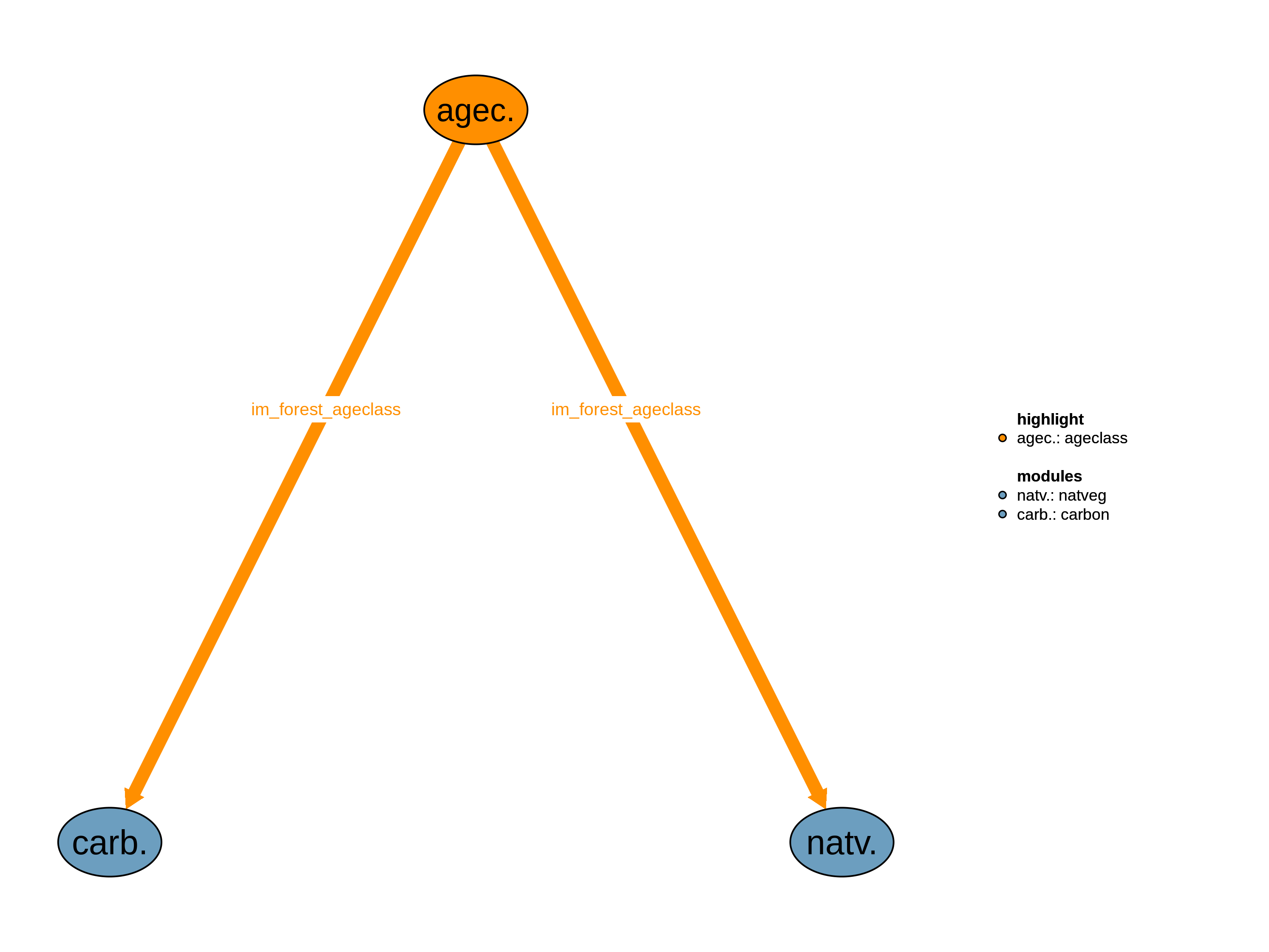
The age-class module provides forest area in age-classes to other
modules. The interface im_forest_ageclass is used in 35_natveg for the initialization of secondary
forest areas.
| Description | Unit | |
|---|---|---|
| im_forest_ageclass (j, ac) |
Forest area in 5-year age-classes | \(10^6 ha\) |
This realization provides forest area in age-classes
im_forest_ageclass, by default
(c28_ageclass_source=gami) from GAMI v2.1 (Besnard et al.
2024) or, with c28_ageclass_source=gfad, from
the Global Forest Age Dataset (GFAD V1.1) Poulter et al. (2019).
Limitations The age-class data give the age of forest but not why it is young. In reality much young forest is repeatedly reset by disturbances (shifting cultivation, fire, small-scale clearing) that MAgPIE does not represent explicitly, so it would not all grow into old forest. Module 35_natveg accounts for this when it initialises secondary forest from
im_forest_ageclass.
| Description | Unit | A | |
|---|---|---|---|
| f28_forestageclasses (j, ac_gfad) |
Forest area in 15 10-year age classes | \(Mha\) | x |
| description | |
|---|---|
| ac | Age classes |
| ac_est(ac) | Dynamic subset of age classes for establishment |
| ac_gfad | Forest age classes in GFAD data set |
| ac_gfad_to_ac(ac_gfad, ac) | mapping between ac and ac_gfad |
| ac_sub(ac) | Dynamic subset of age classes excluding establishment |
| ac_young(ac) | Young age classes (below about 35 years) |
| age | Population age groups |
| j | number of LPJ cells |
| t(t_all) | Simulated time periods |
Abhijeet Mishra, Florian Humpenöder