
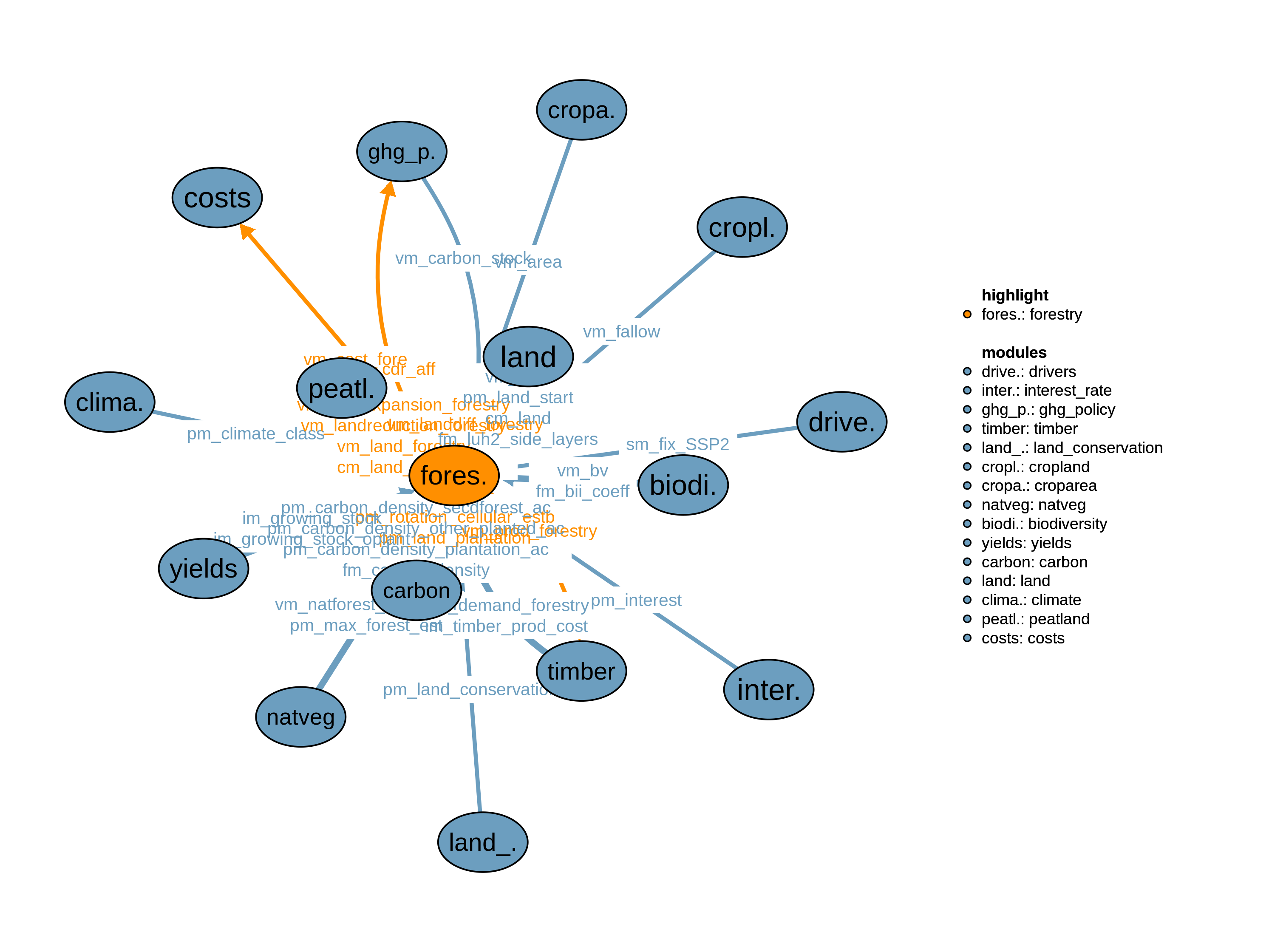
The forestry module describes the constraints under which three
different types of managed age-class forests exist: plantations used for
wood harvesting (plant), prescribed re/afforestation based on existing
national policies (ndc) and endogenous CO2-price driven re/afforestation
(aff) (Humpenöder et al. (2022)). These types of managed forests
are made available to other modules via the interface
vm_land_forestry. At the same time, the module calculates
the corresponding carbon stocks and biodiversity values for all three
types of managed forest. The module provides expected carbon dioxide
removal (CDR) from endogenous re/afforestation to the GHG policy module
(56_ghg_policy). Costs related to
managed forests, including costs for harvesting, establishment and
management, are provided to the cost module (11_costs).
| Description | Unit | A | |
|---|---|---|---|
| fm_bii_coeff (bii_class44, potnatveg) |
Biodiversity Intactness Index coefficients | \(unitless\) | x |
| fm_carbon_density (t_all, j, land, c_pools) |
LPJmL carbon density for land and carbon pools | \(tC/ha\) | x |
| fm_luh2_side_layers (j, luh2_side_layers10) |
luh2 side layers | \(grid cell share\) | x |
| im_growing_stock (t, j, ac, land_timber) |
Harvestable stem biomass per ha by age class | \(tDM/ha\) | x |
| im_growing_stock_oplant (t, j, ac) |
Harvestable stem biomass per ha of other-planted forest by age class | \(tDM/ha\) | x |
| im_timber_prod_cost (i, kforestry) |
Regional base cost for timber production based on UNECE market prices | \(USD_{17MER}/tDM\) | x |
| pcm_land (j, land) |
Land area in previous time step including possible changes after optimization | \(10^6 ha\) | x |
| pm_carbon_density_other_planted_ac (t_all, j, ac, ag_pools) |
Vegetation other-planted forest carbon density - natveg-derived curve read from f52_growth_par other_planted | \(tC/ha\) | x |
| pm_carbon_density_plantation_ac (t_all, j, ac, ag_pools) |
Vegetation plantation carbon density for age classes and carbon pools | \(tC/ha\) | x |
| pm_carbon_density_secdforest_ac (t_all, j, ac, ag_pools) |
Vegetation secondary forest carbon density for age classes and carbon pools | \(tC/ha\) | x |
| pm_climate_class (j, clcl) |
Koeppen-Geiger climate classification on the simulation cluster level | \(1\) | x |
| pm_demand_forestry (t_ext, i, kforestry) |
Extended demand for timber beyond simulation | \(10^6 tDM/yr\) | x |
| pm_interest (t_all, i) |
Interest rate in each region and timestep | \(\%/yr\) | x |
| pm_land_conservation (t, j, land, consv_type) |
Land protection and restoration for all land types | \(10^6 ha\) | x |
| pm_land_start (j, land) |
Land initialization area | \(10^6 ha\) | x |
| pm_max_forest_est (t, j) |
Overall forest establishment potential in current time step | \(10^6 ha\) | x |
| sm_fix_SSP2 | year until which all parameters are fixed to SSP2 values | \(year\) | x |
| vm_area (j, kcr, w) |
Agricultural production area | \(10^6 ha\) | x |
| vm_bv (j, landcover44, potnatveg) |
Biodiversity stock for all land cover classes | \(Mha\) | x |
| vm_carbon_stock (j, land, c_pools, stockType) |
Carbon stock in vegetation soil and litter for different land types | \(10^6 tC\) | x |
| vm_fallow (j) |
Fallow land is temporarily fallow cropland | \(10^6 ha\) | x |
| vm_land (j, land) |
Land area of the different land types | \(10^6 ha\) | x |
| vm_natforest_reduction (j) |
Natural forest reduction | \(10^6 ha\) | x |
| Description | Unit | |
|---|---|---|
| pcm_land_forestry (j, type32) |
Forestry land pools | \(10^6 ha\) |
| pm_land_plantation (j, ac) |
Plantation land by age class for growing stock calibration | \(10^6 ha\) |
| pm_rotation_cellular_estb (t_all, j) |
Establishment rotation length translated to age classes on cellular level | \(1\) |
| vm_cdr_aff (j, ac, aff_effect) |
Expected bgc (CDR) and local bph effects of afforestation depending on planning horizon | \(10^6 tC\) |
| vm_cost_fore (i) |
Forestry costs | \(10^6 USD\) |
| vm_land_forestry (j, type32) |
Forestry land pools | \(10^6 ha\) |
| vm_landdiff_forestry | Aggregated difference in forestry land compared to previous timestep | \(10^6 ha\) |
| vm_landexpansion_forestry (j, type32) |
Forestry land expansion | \(10^6 ha\) |
| vm_landreduction_forestry (j, type32) |
Forestry land reduction | \(10^6 ha\) |
| vm_prod_forestry (j, kforestry) |
Production of woody biomass from commercial plantations | \(10^6 tDM/yr\) |
The main features of this realization are re/afforestation for CDR
and timber production. Re/afforestation can be modelled exogenously
(prescribed by NPI/NDC policies) and/or endogenously (incentivized by a
reward for CDR). National policies implemented (NPI) and nationally
determined contributions to the Paris agreement (NDC) for
re/afforestation are based on country reports. The interface
vm_cdr_aff includes the expected CDR and local bph effects
from re/afforestation depending on the planning horizon
s32_planning_horizon. The reward for CDR and local bph
effects from re/afforestation is calculated in the 56_ghg_policy module. In this realization,
re/afforestation is modeled by default as regrowth of natural vegetation
(see Humpenöder et al. (2014) for details on the implemenation).
The regrowth of natural vegetation follows S-shaped growth curves
parametrized via module 52_carbon, which
provides three forest growth curves along the FRA continuum: naturally
regenerating forest (Robinson et al. 2025), other planted
forest (a natveg-derived curve), and plantations (Bukoski et al. 2022). Additionally this
module handles the production of two timber products i.e., wood and
woodfuel from the harvestable managed-forestry pools (timber plantations
and other planted forest) while still accounting for afforestation
policies. New plantations are also established in the simulation step to
account for future timber demand. Plantation rotation lengths are an
external per-biome input (f32_plant_rotation, area-weighted
over Koeppen classes and converted to 5-yr age classes) and are the
single source of truth for both the cellular (establishment/harvest)
rotation and the regional (economic) rotation. For harvesting decisions
we assume that land owners stick to their establishment decision,
e.g. if a plantation has been established with a rotation length of 30
years it will be harvested after 30 years, even so the rotation length
in the prevailing time step, used for establishment, is shorter or
longer. See Mishra et al. (2021)
for more details. Replanted plantations receive a reduced establishment
cost (s32_est_cost_plant_reest) reflecting lower costs for
re-establishment on recently harvested plantation land.
The direct costs for timber plantations and re/afforestation
vm_cost_fore include establishment cost for new forests,
recurring maintenance and monitoring costs for standing forests as well
as harvesting costs for timber plantations. In addition, this type of
forest management (including re/afforestation) may cause costs in other
parts of the model such as costs for technological change 13_tc or land expansion 39_landconversion.
\[\begin{multline*} vm\_cost\_fore(i2) = v32\_cost\_recur(i2) + v32\_cost\_establishment(i2) + v32\_cost\_hvarea(i2) + \sum_{cell(i2,j2)} v32\_land\_missing(j2) \cdot s32\_free\_land\_cost + \sum_{cell(i2,j2)} v32\_ndc\_area\_missing(j2) \cdot s32\_free\_land\_cost \end{multline*}\]
The interface vm_cdr_aff provides the projected
biogeochemical (bgc) carbon sequestration and the local biophysical
(bph) warming/cooling effects of an afforestation activity for a
planning horizon of 50 years s32_planning_horizon to the 56_ghg_policy module.
\[\begin{multline*} vm\_cdr\_aff(j2,ac,"bgc") = \sum_{ac\_est} v32\_land(j2,"aff",ac\_est) \cdot \sum_{ct} p32\_cdr\_ac(ct,j2,ac) \end{multline*}\]
\[\begin{multline*} vm\_cdr\_aff(j2,ac,"bph") = \sum_{ac\_est} v32\_land(j2,"aff",ac\_est) \cdot p32\_aff\_bgp(j2,ac) \end{multline*}\]
ac_est can only increase if total afforested land increases
\[\begin{multline*} \sum_{ac\_est} v32\_land(j2,"aff",ac\_est) \leq \sum_{ac} v32\_land(j2,"aff",ac) - \sum_{ct,ac} p32\_land(ct,j2,"aff",ac) \end{multline*}\]
The interface vm_land provides aggregated forestry land
pools (type32) to other modules.
\[\begin{multline*} vm\_land(j2,"forestry") = \sum_{type32,ac} v32\_land(j2,type32,ac) \end{multline*}\]
\[\begin{multline*} vm\_land\_forestry(j2,type32) = \sum_{ac} v32\_land(j2,type32,ac) \end{multline*}\]
\[\begin{multline*} vm\_landexpansion\_forestry(j2,type32) = v32\_land\_expansion(j2,type32) - \sum_{harvest32\$sameas(type32,harvest32)} v32\_land\_replant(j2,harvest32) \end{multline*}\]
\[\begin{multline*} vm\_landreduction\_forestry(j2,type32) = \sum_{ac\_sub} v32\_land\_reduction(j2,type32,ac\_sub) - \sum_{harvest32\$sameas(type32,harvest32)} v32\_land\_replant(j2,harvest32) \end{multline*}\]
\[\begin{multline*} v32\_land\_replant(j2,harvest32) = \sum_{ac\_sub} v32\_hvarea\_forestry(j2,harvest32,ac\_sub) \cdot \sum_{cell(i2,j2)}\left( min\left(1, \sum_{ct} p32\_future\_to\_current\_demand\_ratio(ct,i2)\right)\right)\$s32\_establishment\_dynamic \end{multline*}\]
The constraint q32_aff_pol accounts for the exogenous
re/afforestation prescribed by NPI/NDC policies.
\[\begin{multline*} \sum_{ac\_est} v32\_land(j2,"ndc",ac\_est) + v32\_ndc\_area\_missing(j2) = \sum_{ct} p32\_aff\_pol\_timestep(ct,j2) \end{multline*}\]
The constraint q32_ndc_aff_limit makes sure that NPI/NDC
re/afforestation does not happen at the cost of forests and other
natural vegetation.
\[\begin{multline*} \sum_{ct} p32\_aff\_pol\_timestep(ct,j2) \cdot vm\_natforest\_reduction(j2) = 0 \end{multline*}\]
The annual upper limit for re-afforestation is based on an annual
share (s32_annual_aff_limit) of the overall forest
establishment potential (pm_max_forest_est).
\[\begin{multline*} \frac{ vm\_landexpansion\_forestry(j2,"aff") }{ m\_timestep\_length } \leq s32\_annual\_aff\_limit \cdot \sum_{ct} pm\_max\_forest\_est(ct,j2) \end{multline*}\]
The constraint q32_max_aff accounts for the allowed
maximum global endogenous afforestation defined in
i32_max_aff_area_glo. The constraint
q32_max_aff_reg accounts for the allowed maximum regional
endogenous afforestation defined in i32_max_aff_area_reg.
Only one of the two constraints is active, depending on
s32_max_aff_area_glo.
\[\begin{multline*} \sum_{j2,ac} v32\_land(j2,"aff",ac) \leq \sum_{ct} p32\_max\_aff\_area\_glo(ct) \end{multline*}\]
\[\begin{multline*} \sum_{cell(i2,j2),ac} v32\_land(j2,"aff",ac) \leq \sum_{ct} p32\_max\_aff\_area\_reg(ct,i2) \end{multline*}\]
Forestry above ground carbon stocks are calculated as the product of
forestry land (v32_land) and the area weighted mean of
carbon density for carbon pools
(p32_carbon_density_ac).
\[\begin{multline*} vm\_carbon\_stock(j2,"forestry",ag\_pools,stockType) = m\_carbon\_stock\_ac(v32\_land,p32\_carbon\_density\_ac,"type32,ac","type32,ac\_sub") \end{multline*}\]
Forestry land expansion and reduction is calculated as follows:
\[\begin{multline*} vm\_landdiff\_forestry = \sum_{j2,type32}\left( v32\_land\_expansion(j2,type32) + \sum_{ac\_sub} v32\_land\_reduction(j2,type32,ac\_sub)\right) \end{multline*}\]
\[\begin{multline*} v32\_land\_expansion(j2,type32) = \sum_{ac\_est} v32\_land(j2,type32,ac\_est) \end{multline*}\]
\[\begin{multline*} v32\_land\_reduction(j2,type32,ac\_sub) = pc32\_land(j2,type32,ac\_sub) - v32\_land(j2,type32,ac\_sub) \end{multline*}\]
\[\begin{multline*} vm\_bv(j2,"aff\_co2p",potnatveg) = \sum_{bii\_class\_secd}\left( \sum\left(ac\_to\_bii\_class\_secd(ac,bii\_class\_secd), v32\_land(j2,"aff",ac)\right) \cdot p32\_bii\_coeff("aff",bii\_class\_secd,potnatveg)\right) \cdot fm\_luh2\_side\_layers(j2,potnatveg) \end{multline*}\]
\[\begin{multline*} vm\_bv(j2,"aff\_ndc",potnatveg) = \sum_{bii\_class\_secd}\left(\sum_{ac\_to\_bii\_class\_secd(ac,bii\_class\_secd)} v32\_land(j2,"ndc",ac) \cdot p32\_bii\_coeff("ndc",bii\_class\_secd,potnatveg) + \sum_{ac\_to\_bii\_class\_secd(ac,bii\_class\_secd)} v32\_land(j2,"other\_planted",ac) \cdot p32\_bii\_coeff("other\_planted",bii\_class\_secd,potnatveg)\right) \cdot fm\_luh2\_side\_layers(j2,potnatveg) \end{multline*}\]
\[\begin{multline*} vm\_bv(j2,"plant",potnatveg) = \sum_{bii\_class\_secd}\left( \sum\left(ac\_to\_bii\_class\_secd(ac,bii\_class\_secd), v32\_land(j2,"plant",ac)\right) \cdot p32\_bii\_coeff("plant",bii\_class\_secd,potnatveg)\right) \cdot fm\_luh2\_side\_layers(j2,potnatveg) \end{multline*}\]
Cost of new plantations establishment
v32_cost_establishment is the investment made in setting up
new plantations but also accounts for the expected value of future
harvesting costs. This makes sure that the model sticks to reasonable
plantation patterns over time. Present value of harvesting costs is
(1+pm_interest)^p32_rotation_regional and
annuity factor of pm_interest/(1+pm_interest)
averages the cost of this investment over time.
Replanted plantation area (v32_land_replant) receives a
reduced establishment cost (s32_est_cost_plant_reest = 1230
USD/ha, 50% of full p32_est_cost("plant") = 2460 USD/ha).
This reflects that replanting on recently harvested plantation land is
cheaper than new establishment: no land clearing needed, existing road
infrastructure, known site productivity. The cost reduction is
implemented by subtracting the difference
(p32_est_cost("plant") - s32_est_cost_plant_reest) for
replanted area from the total establishment cost.
\[\begin{multline*} v32\_cost\_establishment(i2) = \left(\sum_{cell(i2,j2),type32,ac\_est}\left( v32\_land(j2,type32,ac\_est) \cdot p32\_est\_cost(type32)\right) - \sum_{cell(i2,j2),harvest32}\left( v32\_land\_replant(j2,harvest32) \cdot \left(p32\_est\_cost(harvest32) - s32\_est\_cost\_plant\_reest\right)\right) \right) \cdot \sum_{ct}\left(\frac{pm\_interest(ct,i2)}{\left(1+pm\_interest(ct,i2)\right)}\right) +\frac{ \sum_{ct,kforestry}\left( v32\_prod\_forestry\_future(i2) \cdot p32\_forestry\_product\_dist(ct,i2,kforestry) \cdot im\_timber\_prod\_cost(i2,kforestry)\right) }{ \left(\left(1+\sum_{ct}pm\_interest(ct,i2)\right)^{\sum_{ct}\left( p32\_rotation\_regional(ct,i2) \cdot 5\right)}\right)} \end{multline*}\]
Recurring costs are paid for plantations where the trees have to be regularly monitored and maintained. These costs are only calculated because we see active human intervention in commercial plantations. These costs are paid for trees used for timber production or trees established for re/afforestation purposes.
\[\begin{multline*} v32\_cost\_recur(i2) = \sum_{cell(i2,j2),type32,ac\_sub}\left( v32\_land(j2,type32,ac\_sub) \cdot i32\_recurring\_cost(type32)\right) \end{multline*}\]
New plantations are established in the optimization step based on a
certain percentage (p32_plant_contr) of expected future
demand (p32_demand_forestry_future). As plantation
establishment decisions should also know some indication of expected
future growing stock, we calculate how much harvestable biomass newly
established plantations can realize based on rotation lengths. This is
defined as the expected growing stock at harvest
(i32_growing_stock_at_harvest). Future expected production
is calculated for the establishment decision below and the costs above
based on newly established areas and expected growing stock at
harvest.
\[\begin{multline*} v32\_prod\_forestry\_future(i2) = \frac{ \sum_{cell(i2,j2)}\left( \left(\sum_{ac\_est} v32\_land(j2,"plant",ac\_est) + v32\_land\_missing(j2)\right) \cdot \sum_{ct} i32\_growing\_stock\_at\_harvest(ct,j2)\right) }{ m\_timestep\_length\_forestry } \end{multline*}\]
Future expected production has to be equal or larger than future demand multiplied with the plantation contribution factor.
\[\begin{multline*} v32\_prod\_forestry\_future(i2) \geq \sum_{ct,kforestry} p32\_demand\_forestry\_future(ct,i2,kforestry) \cdot \sum_{ct} p32\_plant\_contr(ct,i2) \end{multline*}\]
Harvested areas are fully re-established at cell level, unless the ratio of future and current demand drops below 1.
\[\begin{multline*} \sum_{ac\_est} v32\_land(j2,harvest32,ac\_est) \geq \sum_{ac\_sub} v32\_hvarea\_forestry(j2,harvest32,ac\_sub) \cdot \sum_{cell(i2,j2)}\left( min\left(1, \sum_{ct} p32\_future\_to\_current\_demand\_ratio(ct,i2)\right)\right) \end{multline*}\]
If plantations should be static (defined by
s32_establishment_static) then the model simply establishes
the amount of plantations which are harvested. this keeps the plantation
area static but accounts for age-class changes and regrowth during every
time step.
\[\begin{multline*} \sum_{ac} v32\_land(j2,harvest32,ac) = \sum_{ac} pc32\_land(j2,harvest32,ac) \end{multline*}\]
This constraint distributes additions to forestry land over ac_est, which depends on the time step length (e.g. ac0 and ac5 for a 10 year time step).
\[\begin{multline*} v32\_land(j2,type32,ac\_est) = \frac{ \sum_{ac\_est2} v32\_land(j2,type32,ac\_est2)}{card(ac\_est2)} \end{multline*}\]
Change in forestry area is the difference between plantation area from previous time step (‘pc32_land’) and optimized plantation area from current time step (‘v32_land’)
\[\begin{multline*} v32\_hvarea\_forestry(j2,harvest32,ac\_sub) = v32\_land\_reduction(j2,harvest32,ac\_sub) \end{multline*}\]
Woody biomass production from the harvestable managed-forestry pools (timber plantations and other planted forest) is calculated by multiplying the area under production with the corresponding growing stock, divided by the timestep length.
\[\begin{multline*} \sum_{kforestry} vm\_prod\_forestry(j2,kforestry) = \frac{ \sum_{harvest32,ac\_sub}\left( v32\_hvarea\_forestry(j2,harvest32,ac\_sub) \cdot p32\_gs\_forestry(j2,ac\_sub,harvest32)\right) }{ m\_timestep\_length\_forestry} \end{multline*}\]
Harvesting cost in plantations is defined as the cost incurred while removing biomass from such forests.
\[\begin{multline*} v32\_cost\_hvarea(i2) = \sum_{ct,cell(i2,j2),harvest32,ac\_sub} v32\_hvarea\_forestry(j2,harvest32,ac\_sub) \cdot s32\_harvesting\_cost \end{multline*}\]
Afforestation switch: 0 = Use natveg growth curve towards LPJmL natural vegetation 1 = Use plantation growth curve (faster than natveg) towards LPJmL natural vegetation
if(s32_aff_plantation = 0,
 p32_carbon_density_ac(t,j,"aff",ac,ag_pools) = pm_carbon_density_secdforest_ac(t,j,ac,ag_pools);
elseif s32_aff_plantation = 1,
 p32_carbon_density_ac(t,j,"aff",ac,ag_pools) = pm_carbon_density_plantation_ac(t,j,ac,ag_pools);
);
Timber plantations carbon densities:
p32_carbon_density_ac(t,j,"plant",ac,ag_pools) = pm_carbon_density_plantation_ac(t,j,ac,ag_pools);NDC carbon densities are natveg carbon densities.
p32_carbon_density_ac(t,j,"ndc",ac,ag_pools) = pm_carbon_density_secdforest_ac(t,j,ac,ag_pools);Other-planted (FRA “other planted”) carbon densities: the natveg-derived curve read from f52_growth_par other_planted (built in module 52 = natveg curve, same shape, rate scaled per biome). CRITICAL: must be set before q32_carbon (which sums the full type32 set) or other_planted would be booked at density 0.
p32_carbon_density_ac(t,j,"other_planted",ac,ag_pools) = pm_carbon_density_other_planted_ac(t,j,ac,ag_pools);CDR from afforestation for each age-class, depending on planning horizon.
p32_cdr_ac(t,j,ac)$(ord(ac) > 1 AND (ord(ac)-1) <= s32_planning_horizon/5)
= p32_carbon_density_ac(t,j,"aff",ac,"vegc") - p32_carbon_density_ac(t,j,"aff",ac-1,"vegc");
p32_disturbance_loss_ftype32(t,j,"aff",ac_sub) = pc32_land(j,"aff",ac_sub) * f32_forest_shock(t,"%c32_shock_scenario%") * m_timestep_length;
pc32_land(j,"aff",ac_est) = pc32_land(j,"aff",ac_est) + sum(ac_sub,p32_disturbance_loss_ftype32(t,j,"aff",ac_sub))/card(ac_est2);
pc32_land(j,"aff",ac_sub) = pc32_land(j,"aff",ac_sub) - p32_disturbance_loss_ftype32(t,j,"aff",ac_sub);
Regrowth of natural vegetation (natural succession) is modelled by shifting age-classes according to time step length. For first year of simulation, the shift is just 1. Division by 5 happends because the age-classes exist in 5 year steps
s32_shift = m_yeardiff_forestry(t)/5;Exchange land information after optimization
pc32_land(j,type32,ac) = v32_land.l(j,type32,ac);Limitations Rotation lengths for timber plantations are not endogenous.
| Description | Unit | A | |
|---|---|---|---|
| f32_aff_bgp (j, bgp32) |
Biogeophysical temperature change of afforestation | \(degree C\) | x |
| f32_aff_mask (j) |
afforestation mask | \(binary\) | x |
| f32_aff_pol (t_all, j, pol32) |
npi+ndc+affexp+ndcdelay re-afforestation policy | \(Mha new forest wrt to 2010\) | x |
| f32_forest_shock (t_all, shock_scen32) |
Forest carbon shock scenarios | \(area share affected/year\) | x |
| f32_max_aff_area (i) |
Maximum regional afforestation area | \(10^6 ha\) | x |
| f32_plant_rotation (clcl) |
Representative managed-plantation rotation length by Koeppen biome | \(yr\) | x |
| f32_plantedforest (i) |
Share of plantation forest in planted forest | \(1\) | x |
| f32_tcre (j, tcre32) |
Transient surface temperature response to CO2 emission | \(degree C/tC/ha\) | x |
| i32_growing_stock_at_harvest (t, j) |
Expected growing stock at rotation age for new plantations | \(tDM/ha\) | x |
| i32_plant_contr_growth_fader (t_all) |
Fader for growth rate of timber plantation share | \(percent\) | x |
| i32_recurring_cost (type32) |
Recurring costs | \(USD_{17MER}/ha\) | x |
| p32_aff_bgp (j, ac) |
Biophysical impact of afforestation | \(tCeq/ha\) | x |
| p32_aff_pol (t, j) |
NDC forest stock | \(10^6 ha\) | x |
| p32_aff_pol_timestep (t, j) |
NDC afforestation per time step | \(10^6 ha\) | x |
| p32_aff_pot (t, j) |
Potential afforestation area | \(10^6 ha\) | x |
| p32_bii_coeff (type32, bii_class_secd, potnatveg) |
bii coeff | \(1\) | x |
| p32_carbon_density_ac (t, j, type32, ac, ag_pools) |
Carbon density for ac and ag_pools | \(tC/ha\) | x |
| p32_cdr_ac (t, j, ac) |
Non-cumulative CDR from afforestation plantations for each age-class depending on planning horizon | \(tC/ha\) | x |
| p32_demand_forestry_future (t, i, kforestry) |
Future forestry demand in current time step | \(tDM/yr\) | x |
| p32_disturbance_loss_ftype32 (t, j, type32, ac) |
Loss due to disturbances in all plantation type forests | \(10^6 ha\) | x |
| p32_est_cost (type32) |
Establishment cost | \(USD_{17MER}/ha\) | x |
| p32_forestry_check | Forestry-area conservation check for the sub-pool initialisation | \(10^6 ha\) | x |
| p32_forestry_product_dist (t, i, kforestry) |
Distribution of wood products | \(1\) | x |
| p32_future_to_current_demand_ratio (t, i) |
Ratio of future and current timber demand | \(1\) | x |
| p32_gs_forestry (j, ac, harvest32) |
Growing stock of the harvestable forestry pools by age class | \(tDM/ha\) | x |
| p32_land (t, j, type32, ac) |
Forestry land pools before optimization | \(10^6 ha\) | x |
| p32_land_start_ac (j, type32, ac) |
Saving first value of starting land | \(10^6 ha\) | x |
| p32_max_aff_area_glo (t) |
Remaining afforestation area wrt to the maximum exogenous target over time | \(10^6 ha\) | x |
| p32_max_aff_area_reg (t, i) |
Remaining regional afforestation area wrt to the maximum exogenous target over time | \(10^6 ha\) | x |
| p32_ncells (i) |
Number of cells in each region | \(1\) | x |
| p32_plant_contr (t, i) |
Share of roundwood production coming from timber plantations | \(percent\) | x |
| p32_plant_rotation_yr (j) |
Cellular area-weighted external per-biome plantation rotation length | \(yr\) | x |
| p32_plantedforest (i) |
Planted forest | \(10^6 ha\) | x |
| p32_rotation_cellular_harvesting (t_all, j) |
Harvesting rotation length of plantations translated to age class equivalent for future | \(1\) | x |
| p32_rotation_regional (t_all, i) |
Regional average rotation length of plantations translated to age class equivalent for future | \(1\) | x |
| p32_tcre_glo (j) |
Global mean Transient Climate Response to cumulative Emissions | \(degree C/tC/ha\) | x |
| pc32_land (j, type32, ac) |
Forestry land pools in current time step | \(10^6 ha\) | x |
| pc32_plant_contr_ini (i) |
Initial share of roundwood production coming from timber plantations | \(percent\) | x |
| pc32_prod_forestry_ini (i) |
Initial production from timber plantations | \(10^6 tDM/yr\) | x |
| q32_aff_est (j) |
Afforestation constraint for establishment age classes | \(10^6 ha\) | x |
| q32_aff_pol (j) |
Afforestation policy constraint | \(10^6 ha\) | x |
| q32_bgp_aff (j, ac) |
Biophysical afforestation calculation | \(10^6 tCeq\) | x |
| q32_bv_aff (j, potnatveg) |
Biodiversity value for aff forestry land | \(Mha\) | x |
| q32_bv_ndc (j, potnatveg) |
Biodiversity value for ndc forestry land | \(Mha\) | x |
| q32_bv_plant (j, potnatveg) |
Biodiversity value for plantations | \(Mha\) | x |
| q32_carbon (j, ag_pools, stockType) |
Forestry carbon stock calculation | \(10^6 tC\) | x |
| q32_cdr_aff (j, ac) |
Calculation of CDR from afforestation | \(10^6 tC\) | x |
| q32_co2p_aff_limit (j) |
Annual upper limit for re-afforestation | \(10^6 ha/yr\) | x |
| q32_cost_establishment (i) |
Present value of cost of establishment | \(10^6 USD\) | x |
| q32_cost_hvarea (i) |
Cost of harvesting timber from forests | \(10^6 USD_{17MER}/yr\) | x |
| q32_cost_recur (i) |
Recurring costs | \(10^6 USD\) | x |
| q32_cost_total (i) |
Total forestry costs constraint | \(10^6 USD\) | x |
| q32_establishment_demand (i) |
Future expected production of woody biomass from commercial plantations | \(10^6 tDM/yr\) | x |
| q32_establishment_fixed (j, harvest32) |
Establishment in current time step for future demand | \(10^6 ha\) | x |
| q32_establishment_hvarea (j, harvest32) |
Establishment in current time step for future demand | \(10^6 ha\) | x |
| q32_forestry_est (j, type32, ac) |
Distribution of forestry establishment over ac_est | \(10^6 ha\) | x |
| q32_hvarea_forestry (j, harvest32, ac) |
Plantations area harvest | \(10^6 ha\) | x |
| q32_land (j) |
Land constraint | \(10^6 ha\) | x |
| q32_land_diff | Aggregated difference in forestry land compared to previous timestep | \(10^6 ha\) | x |
| q32_land_expansion (j, type32) |
Land expansion | \(10^6 ha\) | x |
| q32_land_expansion_forestry (j, type32) |
Forestry land expansion | \(10^6 ha\) | x |
| q32_land_reduction (j, type32, ac) |
Land contraction | \(10^6 ha\) | x |
| q32_land_reduction_forestry (j, type32) |
Forestry land reduction | \(10^6 ha\) | x |
| q32_land_replant (j, harvest32) |
Harvested and replanted area in harvestable managed forestry | \(10^6 ha\) | x |
| q32_land_type32 (j, type32) |
Land constraint | \(10^6 ha\) | x |
| q32_max_aff | Maximum total global afforestation | \(10^6 ha\) | x |
| q32_max_aff_reg (i) |
Maximum total regional afforestation | \(10^6 ha\) | x |
| q32_ndc_aff_limit (j) |
Constraint for avoiding that NPI NDC re-afforestation happens at the cost of forests and other natural vegetation | \(10^6 ha\) | x |
| q32_prod_forestry (j) |
Production of woody biomass from commercial plantations | \(10^6 tDM/yr\) | x |
| q32_prod_forestry_future (i) |
Future expected production of woody biomass from commercial plantations | \(10^6 tDM/yr\) | x |
| s32_aff_bii_coeff | BII coefficent to be used for CO2 price driven afforestation 0=natural vegetation 1=plantation | \(1\) | x |
| s32_aff_plantation | Switch for using growth curves for afforestation 0=natveg 1=plantations | \(1\) | x |
| s32_aff_prot | Switch for protection of afforested areas | \(0=until end of planning horizon 1=forever\) | x |
| s32_ageclass_length | Length of one age class | \(yr\) | x |
| s32_annual_aff_limit | Annual upper limit for re-afforestation as share of overall forest establishment potential | \(1\) | x |
| s32_demand_establishment | Boolean switch for establishment demand assumption 1=forward looking 0=static | \(1\) | x |
| s32_est_cost_natveg | Establishment cost for natural vegetation | \(USD_{17MER}/ha\) | x |
| s32_est_cost_plant | Establishment cost for plantations | \(USD_{17MER}/ha\) | x |
| s32_est_cost_plant_reest | Re-establishment cost for replanted plantations | \(USD_{17MER}/ha\) | x |
| s32_establishment_dynamic | If plantations should be dynamic | \(including establishment and harvest decisions\) | x |
| s32_establishment_static | Static plantations with no establishment no harvest no regrowth | x | |
| s32_free_land_cost | Penalty for technial area balance term | \(USD_{17MER}/ha\) | x |
| s32_harvesting_cost | Harvesting cost | \(USD_{17MER}/ha\) | x |
| s32_hvarea | Flag for harvested area and establishment | \(0=zero 1=exogenous 2=endogenous\) | x |
| s32_initial_distribution | Switch to Activate ageclass distribution in plantations 0=off 1=equal distribution | x | |
| s32_max_aff_area | Maximum total global afforestation | \(10^6 ha\) | x |
| s32_max_aff_area_glo | Switch for global or regional afforestation constraint | \(1\) | x |
| s32_max_rotation | Maximum commercial plantation rotation | \(yr\) | x |
| s32_max_self_suff | Upper ceiling for the self sufficiency used in calculation for establishment decision | \(1\) | x |
| s32_min_plant_shr | Minimum share of plantations in planted forests | \(1\) | x |
| s32_npi_ndc_reversal | Year in which NPI NDC reversal should take place | \(1\) | x |
| s32_planning_horizon | Afforestation planing horizon | \(years\) | x |
| s32_plant_contr_growth_endvalue | End value for plantation contribution growth fader | \(percent/year\) | x |
| s32_plant_contr_growth_endyear | End year for plantation contribution growth fader | \(year\) | x |
| s32_plant_contr_growth_startvalue | Start value for plantation contribution growth fader | \(percent/year\) | x |
| s32_plant_contr_growth_startyear | Start year for plantation contribution growth fader | \(year\) | x |
| s32_plant_contr_max | Maximum plantation contribution for establishment decision | \(percent\) | x |
| s32_recurring_cost | Recurring costs | \(USD_{17MER}/ha\) | x |
| s32_shift | Number of 5-year age-classes corresponding to current time step length | \(1\) | x |
| s32_tcre_local | Switch for local (1) or global (0) TRCE factors | \(1\) | x |
| v32_cost_establishment (i) |
Cost of establishment calculated at the current time step | \(10^6 USD\) | x |
| v32_cost_hvarea (i) |
Cost of harvesting timber from forests | \(10^6 USD_{17MER}/yr\) | x |
| v32_cost_recur (i) |
Recurring forest management costs | \(USD_{17MER}/ha\) | x |
| v32_hvarea_forestry (j, harvest32, ac) |
Harvested area from harvestable managed forestry | \(10^6 ha\) | x |
| v32_land (j, type32, ac) |
Forestry land pools | \(10^6 ha\) | x |
| v32_land_expansion (j, type32) |
Forestry land expansion | \(10^6 ha\) | x |
| v32_land_missing (j) |
Technical area balance term for timber plantation establishment | \(10^6 ha\) | x |
| v32_land_reduction (j, type32, ac) |
Forestry land reduction | \(10^6 ha\) | x |
| v32_land_replant (j, harvest32) |
Harvested and replanted area in harvestable managed forestry | \(10^6 ha\) | x |
| v32_ndc_area_missing (j) |
Technical variable reflecting missing area towards the NPI NDC re-afforestation target | \(10^6 ha\) | x |
| v32_prod_forestry_future (i) |
Future expected production of woody biomass from commercial plantations | \(10^6 tDM/yr\) | x |
| description | |
|---|---|
| ac | Age classes |
| ac_bph(ac) | fade-in of bph effect over age-classes |
| ac_est(ac) | Dynamic subset of age classes for establishment |
| ac_sub(ac) | Dynamic subset of age classes excluding establishment |
| ac_to_bii_class_secd(ac, bii_class_secd) | Mapping between forest ageclasses and bii coefficent land cover classes |
| aff_effect | biochemical and local biophysical effect of afforestation on climate |
| ag_pools(c_pools) | Above ground carbon pools |
| age | Population age groups |
| bgp32 | biogeophysical effect (degree C) of afforestation on local surface temperature |
| bii_class44 | bii coefficent land cover classes |
| bii_class_secd(bii_class44) | bii coefficent land cover classes secondary vegetation |
| c_pools | Carbon pools |
| cell(i, j) | number of LPJ cells per region i |
| clcl | climate classification types |
| consv_type | Type of land conservation |
| ct(t) | Current time period |
| factors | factors included in factor requirements |
| fcosts32(fcostsALL) | forestry factor cost per annum |
| fcostsALL | forestry factor cost types |
| harvest32(type32) | harvestable managed-forestry pools replanted to the same pool after harvest |
| i | all economic regions |
| i2(i) | World regions (dynamic set) |
| ini32(j, ac) | subset for initialization of timber plantations |
| inter32 | Interpolation of scenario from FAO study on proportion of roundwood production coming from plantations |
| j | number of LPJ cells |
| j2(j) | Spatial Clusters (dynamic set) |
| kcr(kve) | Cropping activities |
| kforestry(k) | forestry products |
| land | Land pools |
| land_timber(land) | land from which timber can be taken away |
| landcover44 | land cover classes used in bii calculation |
| luh2_side_layers10 | side layers from LUH2 |
| pol32 | afforestation policy type |
| potnatveg(luh2_side_layers10) | potentially forested biomes |
| scen32 | Scenario for development of roundwood production share from plantations |
| shock_scen32 | Scenario name of forest carbon shock |
| stockType | Carbon stock types |
| t(t_all) | Simulated time periods |
| t_all(t_ext) | 5-year time periods |
| t_ext | 5-year time periods |
| tcre32 | transient surface temperature response to CO2 emission (degree C per tC) |
| type | GAMS variable attribute used for the output |
| type32 | plantation type |
| w | Water supply type |
Florian Humpenöder, Abhijeet Mishra
09_drivers, 10_land, 11_costs, 12_interest_rate, 14_yields, 22_land_conservation, 29_cropland, 30_croparea, 35_natveg, 44_biodiversity, 45_climate, 52_carbon, 56_ghg_policy, 58_peatland, 73_timber